
Background
Researchers, especially in the field of AI, are faced with the enormous challenge of keeping up with the latest research progress. This domain is a hotbed of activity for both industry and academia. With large numbers of papers published daily, it’s unrealistic for anyone to read them all. Every AI researcher, and indeed researchers in other fields too, contend with the following questions upon discovering a new paper:
* Is this paper worth my time?
* What are the key takeaways of this paper, beyond the abstract?
Answering these questions is not straightforward. Typically, we can’t judge a paper’s quality without reading it thoroughly, and we can’t know more than what the abstract reveals without dedicating time to it. Despite our interest in numerous papers, our time is immensely limited.

The Fabric Project
Fortunately, AI comes to our rescue. Today, I’ll introduce two tools from an amazing project named fabric that have significantly boosted my research efficiency. The Fabric is an open source project created by Daniel Miessler, and being contributed by volunteers in AI and Cybersecurity domains. You can think it as a collection of AI tools which can be integrated into your daily work on computer. With Fabric, we can easily call many useful AI tools from terminals, and pipe the results among them and between other system tools. It’s super useful for improve our work efficiency. I highly recommend this project to anyone who want to leverage AI for higher productivity.
The First Tool
Now, let’s get back to our topic on boosting research efficiency with tools from Fabric.
The first tool, analyze_paper, assists in evaluating a scientific paper’s quality through various factors, such as study design, sample size, p-value (if applicable), consistency of results, and methodology transparency, among others. Finally, it provides scores on novelty, rigor, and empiricism, enabling you to quickly gauge the paper’s strengths and weaknesses and decide whether it’s worth reading.
Let’s take a recent paper “Efficient Inverted Indexes for Approximate Retrieval over Learned Sparse Representations” as an example to demonstrate how to use it.
To use this tool, after installing fabric, simply go to arxiv.org, search the paper, open its HTML link, use command-A or ctrl-A to select all content in this page, and copy it to the system clipboard.
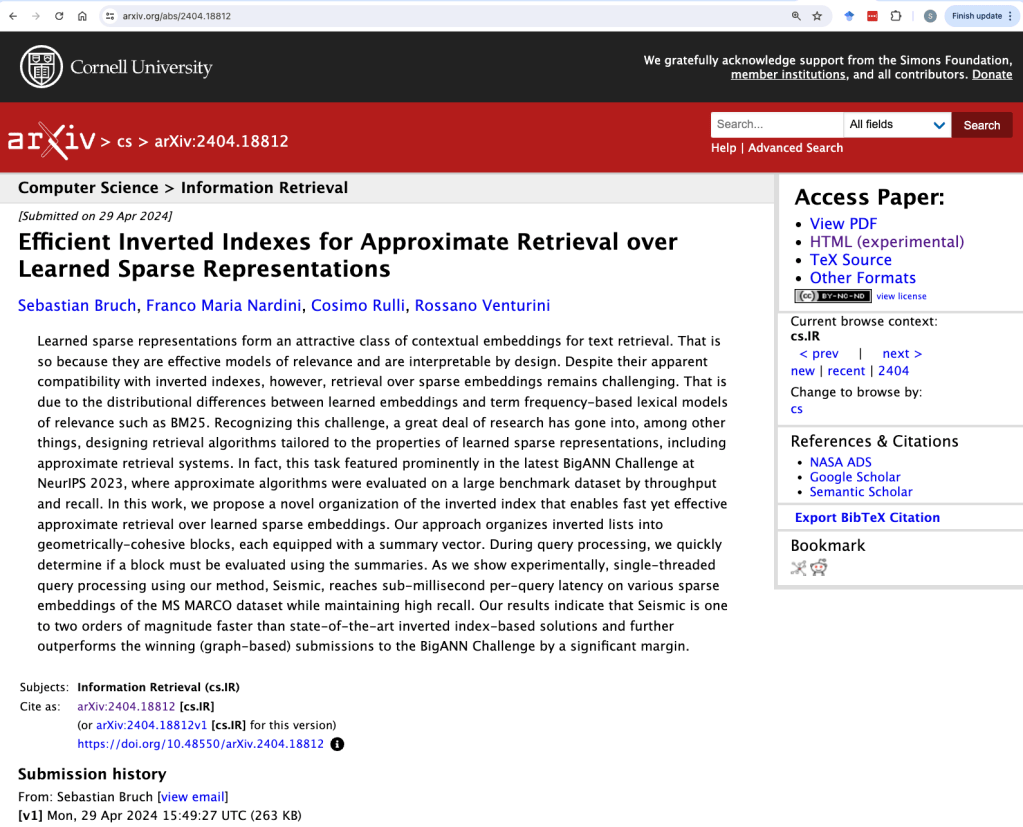
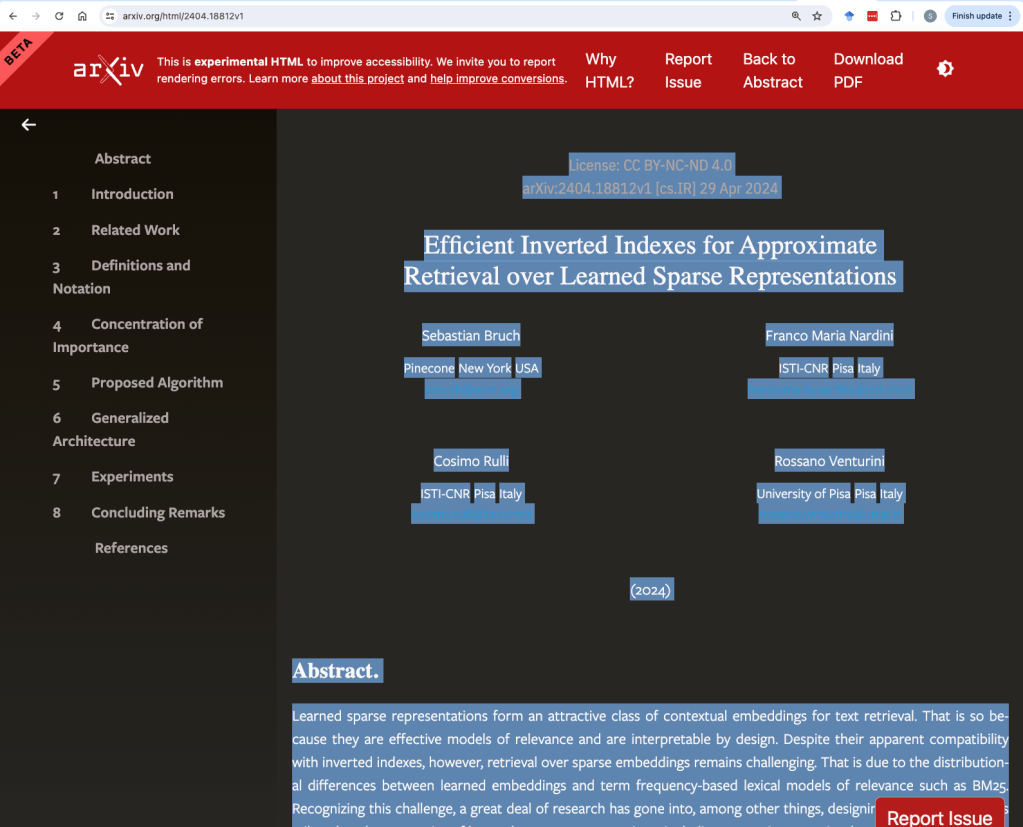
Then run the following command in your terminal, assuming you are using a Mac computer:
pbpaste | fabric --pattern analyze_paper
Or just
pbpaste | analyze_paper
We can use the second command because during installation, Fabric creates system aliases for all its tools, so we don’t need to explicitly call fabric each time.
If you are using Windows, I think you might be able to use:
powershell.exe -command "Get-Clipboard" | analyze_paper
Here’s the command output for the paper we are insterested:
SUMMARY:

Seismic, a novel algorithm for fast, effective retrieval over learned sparse embeddings, significantly outperforms existing methods in efficiency and accuracy.

AUTHORS:

- Sebastian Bruch
- Franco Maria Nardini
- Cosimo Rulli
- Rossano Venturini

AUTHOR ORGANIZATIONS:

- Pinecone, New York, USA
- ISTI-CNR, Pisa, Italy
- University of Pisa, Pisa, Italy

FINDINGS:

- Seismic achieves sub-millisecond query latency with high recall.
- Outperforms state-of-the-art and BigANN Challenge winners.
- Utilizes geometrically-cohesive blocks for efficient retrieval.
- Employs summary vectors for quick block evaluation.
- Demonstrates significant speedup over graph-based and inverted index-based methods.

STUDY DETAILS:

- Focuses on learned sparse representations for text retrieval.
- Introduces a novel inverted index organization.
- Evaluates on Ms Marco dataset with various sparse embeddings.
- Compares against leading algorithms from BigANN Challenge.

STUDY QUALITY:

STUDY DESIGN:

- Novel ANN algorithm leveraging inverted and forward indexes for sparse embeddings.

SAMPLE SIZE:

- Tested on Ms Marco dataset with millions of passages.

CONFIDENCE INTERVALS:

- Not explicitly mentioned, but high recall indicates strong performance.

P-VALUE:

- Not applicable; empirical performance-based evaluation.

EFFECT SIZE:

- Significant speed and accuracy improvements over competitors.

CONSISTENCE OF RESULTS:

- Consistently outperforms across different accuracy levels and datasets.

METHODOLOGY TRANSPARENCY:

- Detailed description of algorithm components and evaluation setup.

STUDY REPRODUCIBILITY:

- Implementation details provided, allowing for replication.

Data Analysis Method:

- Empirical evaluation comparing latency, accuracy, and index size.

CONFLICTS OF INTEREST:

- NONE DETECTED

RESEARCHER'S INTERPRETATION:

- Seismic offers a groundbreaking approach to efficient text retrieval with sparse embeddings.

PAPER QUALITY:

Novelty: 9

- Introduces innovative indexing and retrieval method for sparse embeddings.

Rigor: 8

- Comprehensive empirical evaluation against state-of-the-art methods.

Empiricism: 9

- Strong empirical evidence of superior performance on public datasets.

Rating Chart:

Known         [--------9]    Novel
Weak          [------8---]    Rigorous
Theoretical   [--------9-]     Empirical

FINAL SCORE:

A

- Seismic significantly advances retrieval efficiency and accuracy with no conflicts of interest detected.

SUMMARY STATEMENT:

Seismic revolutionizes retrieval over learned sparse embeddings, offering unmatched speed and accuracy, making it a pivotal advancement in text retrieval technology.
As we can see, the analyze_paper outputs important observations that helps us to evaluate the paper’s overall quality. The scores are given near the end of the analysis, and it gives us a rapid assessment of the paper’s quality.
Important Note: However, we need to keep in mind a few things when we interpret the assessment result. 1)The AI uses the text from the paper to make the observation, and this is not an abosolute objective or accurate one. For example, when the tool evaluates the consistency of results, it sounds like it only takes what the authors say about the result, and the AI will not investigate. If the authors say their result consistently outperform other methods, then AI will just take it. 2) By nauture, any LLM is probablistic and their results are hard to explain. So are the scores generated by this tool. We should not use the score as a reliable metric for paper quality.
The Second Tool
If the paper’s score piques your interest, but you’re still undecided about reading the whole thing, you’ll likely want to know more than just the abstract. This is where the second tool, summarize_paper, proves invaluable.
Summarize_paper reads the paper on your behalf and provides summaries on key points such as foundational ideas, technical details, experiment outcomes, advantages, and limitations. This enables a swift, comprehensive grasp of the paper without investing hours in reading.
I am proud that I wrote this tool and made a small contribution to this project.
The usage of this tool is similar to analyze_paper: copy the full text of the paper from arxiv.org or any other source, and execute a shell command like this:
pbpaste | summarize_paper
You’ll receive an output like this:
**Main Goal and Fundamental Concept:**
The primary objective of the research is to propose a novel organization of the inverted index that enables fast yet effective approximate retrieval over learned sparse embeddings. The core idea is to enhance the efficiency of retrieval systems by organizing inverted lists into geometrically-cohesive blocks equipped with summary vectors, facilitating quick determination during query processing if a block must be evaluated.

**Technical Approach:**
The methodology involves a new algorithm named Seismic, which restructures the inverted index for efficient query processing on learned sparse representations. Seismic partitions inverted lists into blocks that are geometrically cohesive, each accompanied by a summary vector that approximates the inner product with the documents within the block. Query processing leverages these summaries to quickly decide whether to evaluate a block, significantly reducing computational overhead. The approach combines static and dynamic pruning strategies to optimize retrieval times while maintaining high recall.

**Distinctive Features:**
Seismic is distinctive in its use of geometrically-cohesive blocking and summary vectors within the inverted index structure. This setup not only speeds up the retrieval process by allowing quick decisions on block relevance but also maintains high recall, making it significantly faster than traditional methods and even recent graph-based solutions. Furthermore, the method's ability to work effectively with different types of sparse embeddings without requiring extensive modification to the embeddings themselves sets it apart from other retrieval systems.

**Advantages and Limitations:**
The advantages of Seismic include its exceptional speed, achieving sub-millisecond latency per query, and its high recall rates, outperforming state-of-the-art methods by substantial margins. However, the approach may involve complex implementation details concerning the management of geometric blocks and summary vectors. The potential increase in index size due to the additional summary data might also be seen as a limitation, although this is somewhat mitigated by the significant performance gains in query processing speed.

**Conclusion:**
Seismic represents a significant advancement in the field of information retrieval over learned sparse embeddings. By innovatively organizing the inverted index into geometrically-cohesive blocks and employing summary vectors for quick relevance assessment, Seismic achieves remarkable improvements in retrieval speed and efficiency. This approach not only enhances the practical applicability of learned sparse representations in large-scale systems but also sets a new standard for the development of fast, accurate retrieval systems.
Summary
In this blog, I’ve showcased two fabric tools designed to boost research productivity. analyze_paper aids in evaluating paper quality, while summarize_paper provides deep insights into the key content of a paper. I hope you find them as useful as I have.

Leave a comment